Modyfikacje Dynaco
ST-70 :
konwersja układu
ultralinear w tryb pracy triodowej
Stopień końcowy we wzmacniaczach push-pull realizowany jest na dwóch triodach,
tetrodach lub pentodach mocy. We wzmacniaczach PP większą sprawnością charakteryzują
się lampy wielosiatkowe - tetrody i pentody. Tetrody i pentody można łączyć
z transformatorem tak jak triody w sposób "klasyczny" lub w trybie "ultralinear".
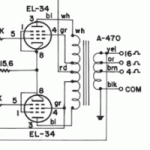 Tryb ultralinear, to taka konstrukcja transformatora wyjściowego, w którym
część napięcia anodowego jest pobierana z uzwojenia anodowego i podawana
na siatkę ekranującą tetrody lub pentody. Powstające lokalne sprzężenie
zwrotne znacznie poprawia liniowość i pasmo przenoszenia oraz poprawia
warunki pracy stopnia końcowego, chociaż zmniejsza nieco sprawność układu.
Tryb ultralinear, to taka konstrukcja transformatora wyjściowego, w którym
część napięcia anodowego jest pobierana z uzwojenia anodowego i podawana
na siatkę ekranującą tetrody lub pentody. Powstające lokalne sprzężenie
zwrotne znacznie poprawia liniowość i pasmo przenoszenia oraz poprawia
warunki pracy stopnia końcowego, chociaż zmniejsza nieco sprawność układu.
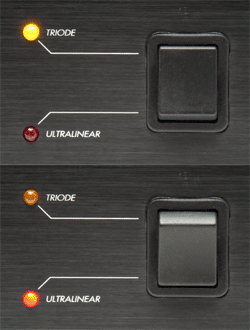
W trybie "ultralinear" tetrody lub pentody pracują "w połowie" pomiędzy
trybem triodowym a tetrodowym czy pentodowym, zachowując część zalet jednego
i drugiego układu: dobrą liniowość triody i wyższą sprawność lamp wielosiatkowych.
Triody, mimo że oddają małą moc ( sprawność rzędu 20% ) są chętnie stosowane
we wzmacniaczach dla zaawansowanych audiofilów i melomanów.
Tetrodę czy pentodę łatwo przełączyć w triodowy tryb pracy, zwierając siatki
ekranujące z anodami przez opornik niewielkiej wartości. Wzmacniacz, oczywiście
będzie miał mniejszą moc, lecz zalety wzmacniacza triodowego pozostaną.
Realizacja przejścia z pentodowego trybu ultralinear w tryb triodowy sprowadza
się zwyczajnie do odłączenia odczepów ultralinear transformatora od siatek
ekranujących lamp EL34 i zmostkowanie tych siatek z anodami przez opornik
100 Ohm.
Poniższy tekst opisuje
poszczególne kroki związane z modyfikacją oryginalnej topologii pracy lamp
mocy w układzie ultralinear do pracy w trybie triodowym:
Opis modyfikacji pochodzi
ze strony www.curcioaudio.com
ST70
OP Triode Conversion.pdf
This document
describes the specific instructions and steps associated with re-wiring
the output stage of the Dynaco Stereo-70 vacuum tube power amplifier from
the original 'ultra-linea' pentode topology to a full triode topology.
Following the
modification, the efficiency of the output stage will decrease and the
resultant power output capability of the amplifier will correspondingly
decrease from 35 Watts RMS to approximately 16 Watts RMS.
Nonetheless,
many have reported favorable audible improvements compared to the original
UL configuration when configured in the triode mode.
Left
Channel:
1. Disconnect
your Stereo 70 power amplifier from the AC mains and allow the
internal
voltages possibly stored in the electrolytic capacitor to discharge over
a
20 minute
period.
2. Remove
the four screws holding the top cover and remove the top cover.
3. Next remove
the bottom plate of the amplifier. You will now be exposed to the
bottom (foil)
side of the printed circuit board and all of the amplifier's direct
wiring. Orient
the amplifier so that the output connections (speaker connections)
are towards
bottom and the input connector (RCA input connector) is at the top.
Beginning
with the Left Channel:
4. Refer
to Figure 1. At pin 4 of V1 disconnect the GREEN Output Transformer
wire. Cleanly
cover the exposed end of the wire with high quality electrical
insulating
tape or heat shrink tubing. This wire will remain un-terminated
therefore
dress appropriately near the chassis corner.
5. Obtain
a 100 ohm, 1/2W, Carbon Film resistor (Mouser # 293-100).
6. Refer
to figure 1- Connect one lead of the 100 ohm resistor to pin 3 of V1.
Connect the
remaining lead of the 100 ohm resistor to pin 4 of V1.
7. At pin
4 of V2 disconnect the GREEN-WHITE Output Transformer wire. Cleanly
cover the
exposed end of the wire with high quality electrical insulating tape or
heat shrink
tubing. This wire will remain un-terminated therefore dress
appropriately
near the chassis corner.
8. Obtain
a 100 ohm, 1/2W, Carbon Film resistor (Mouser # 293-100).
9. Refer
to figure 1- Connect one lead of the 100 ohm resistor to pin 3 of V2.
Connect the
remaining lead of the 100 ohm resistor to pin 4 of V2.
Right
Channel:
10. Refer
to Figure 1. At pin 4 of V6 disconnect the GREEN Output Transformer
wire. Cleanly
cover the exposed end of the wire with high quality electrical
insulating
tape or heat shrink tubing. This wire will remain un-terminated
therefore
dress appropriately near the chassis corner.
11. Obtain
a 100 ohm, 1/2W, Carbon Film resistor (Mouser # 293-100).
12. Refer
to figure 1- Connect one lead of the 100 ohm resistor to pin 3 of V6.
Connect the
remaining lead of the 100 ohm resistor to pin 4 of V6.
13. At pin
4 of V7 disconnect the GREEN-WHITE Output Transformer wire. Cleanly
cover the
exposed end of the wire with high quality electrical insulating tape or
heat shrink
tubing. This wire will remain un-terminated therefore dress
appropriately
near the chassis corner.
14. Obtain
a 100 ohm, 1/2W, Carbon Film resistor (Mouser # 293-100).
15. Refer
to figure 1- Connect one lead of the 100 ohm resistor to pin 3 of V7.
Connect the
remaining lead of the 100 ohm resistor to pin 4 of V7.
16. Rotate
both the Left and Right Bias Adjust potentiometers Fully
Counterclockwise
(when viewed from the top of the amplifier).
17. Position
the amplifier so that you may safely readjust the operating bias in each
channel.
The correct bias voltage as measured on pin #8 of the front panel octal
socket (you
may wish to refer to Dynaco Stereo 70 manual for the details) is 1.56 VDC.
18. If it
is difficult or impossible to set the amplifier operating bias current
you may
wish to execute
the Stereo-70 Bias Expansion modification as described at our
website (www.curcioaudio.com).
19. Replace
the bottom plate and top cover and secure with the four screws.
Home